
How to get better results from taking group fitness classes
Who doesn’t want to get better results from taking group fitness classes? This is an updated version of an older post, with fresh and new tips. Hope you enjoy …
Greetings, group fitness lover!
Let’s start with a little backstory: I’ve been a group fitness instructor for 15 years, and before that, I was a group fitness participant. I teach multiple classes each week, and I’m a believer in the power of working out with others. Not only do I think that people who attend group fitness classes regularly are more consistent with their movement, but I also think that people who attend group fitness classes find more enjoyment in their movement than those who work out alone. It’s just so much more fun with others. You do more with others. And it’s great to have a professional make up the workout and deliver it to you.
Whether you’re new to group fitness or you’ve been going to classes forever, you want to make sure your group fitness classes are serving you. Rather than just going through the motions in the classes you take, put in a little extra effort, and you may see extra results, in both your fitness level and aesthetics too.
From my many years in fitness, I’ve picked up some tips on how to do that. While most of these tips on how to get better results from taking group fitness classes apply to everyone, I sectioned them out for (1) New/Newer and (2) Seasoned participants.
How to get better results from taking group fitness classes

Here are my tips on getting better results from taking group fitness classes …
For the newer participant …
If you’re new/newish, show up early to class and introduce yourself to the instructor so they can help you set up and give you some tips.
If you’re new, you really should approach the instructor before class and tell them that you’re new and let him/her know if you have any limitations and need special modifications. I wouldn’t do this just as the instructor is about to press play, but a few minutes before class kicks off. I love it when new people come to me and tell me they’re new. This is a great thing for both of us. I always have a little just-for-them insight to share that they wouldn’t have gotten if they didn’t let me know they were new.
By the way, sharing your limitations with your instructor is nothing to be embarrassed about, and the instructor will appreciate the fact that you came forward. The advice they give you will help you perform better throughout class, so you can get better results. This will also let the instructor know that they can make eye contact with you and offer suggestions as needed throughout the class so you feel more comfortable.
Even if you’ve been going to a class for a while, it’s always good to speak to the instructor before or after class and let them know more about you and your fitness level. And if anything comes up and you have a nagging pain or issue, your instructor can give you a safe modification you can use in your workout.
Moral of the story: Communication is key! Talk to the instructor and start a dialog, so they can help you get in a great workout.

Instead of hiding in the back, stand toward the middle of the room, so you have a clear view of the instructor.
For the majority of people, I think it’s better to set up toward the front/middle of the classroom, where you can see the instructor super clearly and you can also see a mirror (if there are mirrors in your studio).
Seeking feedback from your reflection in the mirror is very important, but it’s also important to see the instructor clearly, especially if you’re a visual person. I notice when people are new, they like to hide in the back, but it’s actually much harder to see in the back, and that’s not ideal. You don’t want to guess at movements, you want to see what’s expected of you and try to emulate it.
It’s important to remember that even though you attend group fitness classes to be around other people, it’s literally never a competition with those other people. You don’t need to worry about doing everything perfectly or keeping up with your classmates. Focus on doing the movements the very best you can that day, and part of that will come from being able to check on yourself in the mirror and see a full-on view of the instructor demoing the moves.
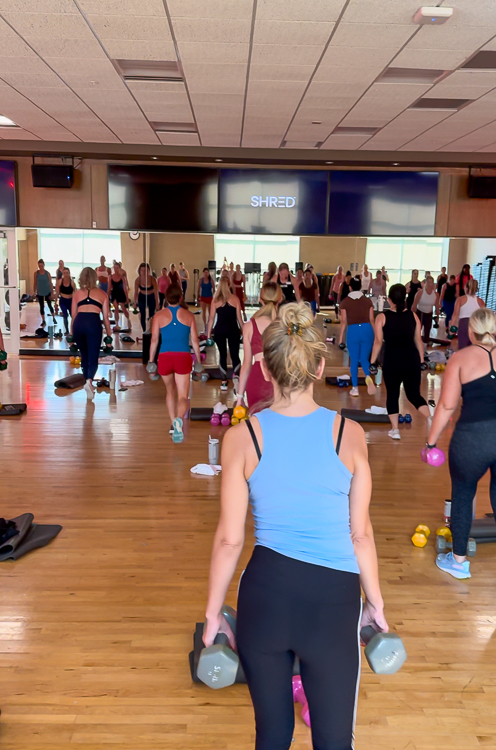
Listen to the instructor’s coaching cues and tips and make adjustments to yourself.
Sometimes I have to remind my classes that everyone who attends group fitness classes should be “coachable.” When you attend a class, listen up to the cues, the corrections and the tips that the instructor gives and implement them. Don’t arrive and think you know everything (because coming to a class with a closed-minded approach will not get you results). Now, this is easier said than done. You may think you’re doing what’s being asked of you, but that doesn’t mean your movements are perfect. You should always be open to improving, receiving feedback and getting a little bit better/stronger with every single class you take.
When people start attending group fitness classes, I notice that they just want to go through the motions and blend in as much as possible. And that’s a good goal for the first few classes, but then, you need to make sure you’re nailing the little things with your form. These small adjustments (like shoulders pulled back and down during a deadrow, or knees aligned with toes during a squat) will take time to improve. Be open to improving and listen up to all the cues coming your way.
And special note: If an instructor seems to be giving a cue multiple times in multiple ways and looking in your general direction, this is probably because you need to make a little fix to your form. Don’t feel bad, just adjust. It’s so common that someone doesn’t seem to get what I’m saying the first time, so I change the way I say it, and all of a sudden they correct themselves.
Give a class at least three tries before you decide if it’s right for you.
Just like you can have an okay meal at a really good restaurant, you may go to a class and think it’s just okay, when it’s usually really quite awesome. Remember that when you try something new and commit to more than one visit. The first time you take a class, you literally only consume about 10 percent of what you learned. That’s not enough to make an informed decision.
It sometimes takes three visits to truly understand the way a workout class operates, and you may find that the second and third time are much more enjoyable once you get the initial class out of the way. I hate to see people come to a class, get overwhelmed, then decide it’s just not for them. I’ve convinced multiple participants to try certain classes they were unsure of several times, and after the third time, if they’re not a fan — I tell them to skip it moving forward.
While in life, I think you should make quick decisions if things don’t feel right. But in group fitness, you need to try a class a few times.
Don’t worry about what anyone else is doing, and don’t be self-conscious about what you’re doing.
Do you know what most people in the group fitness studio are worried about? How they look doing their movements. They’re not all that concerned with how other people look doing movements. Thus, you don’t need to worry about other people judging you. They are busy judging themselves. True story.
One of the number one things I encounter as an instructor/coach is that people feel very worried they are being graded by their fellow classmates, and thus avoid classes or try to hide in the back. However, most people are so worried about their own performance in each workout, that they never bother to look around. I can assure you that no one is watching you to see how you do in your first class, other than the instructor if you’ve let them know you’re new (see #1). Just let loose and try your best.
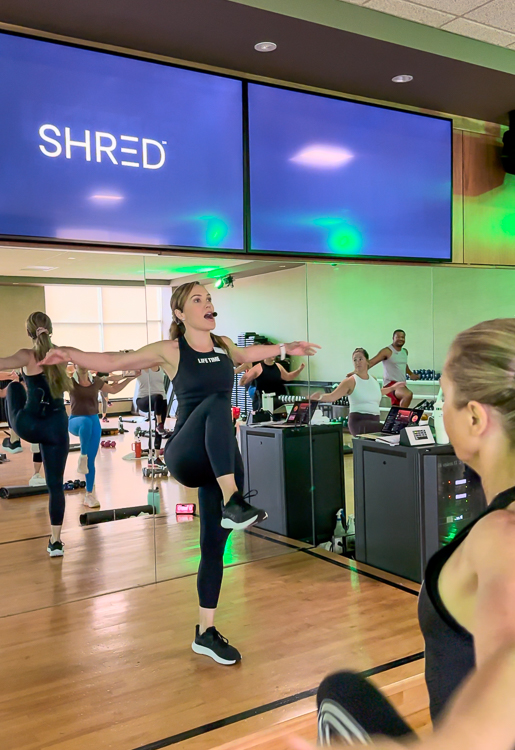
If an instructor gives options or levels, take the introductory level to start and learn to nail it before moving on to the more advanced option/level.
This is another big one. Use the low or easier option, if given, when you’re new and you’re just starting to learn the moves. I always tell new participants to start with the basics, before adding bells and whistles.
If there’s a squat/press movement with a heel lift, try just the squat first, then add the press and/or heel lift when you’re ready. If there are push-ups on the toes or knees, get the knee push-ups under you belt, before going on your toes, etc.
Don’t be a hero by trying to achieve it all in your first few classes. Learn the basics properly, then go on to the more advanced options.
For the more seasoned participant …
Keep track of the weights you’re lifting in each class and know your light, medium and heavy ranges.
I often tell my classes that they need to know which weights they are picking up for which muscle groups. You can put that information in the notes column in your phone, or you can bring a little notebook into the class and jot it down. If you don’t know what you usually use, you’ll have a hard time selecting the right weights moving forward. It shouldn’t be a guessing game. You should know what you can safely lift with good form, and on days when you want to go up, you should know just how much to add to find a new challenge.
While this tip is essential in a lifting class, it also works in a barre or circuit class. Take ownership of knowing what amount of weight you can do for most general movements. And seek to lift a little bit more every few weeks.
I do not think you need to increase your weights every time you come to a class. In fact, you can stay at the same weights for a couple of weeks before you add. And even then, choose a couple muscle groups to go up on, and don’t lift heavier for everything all at once.
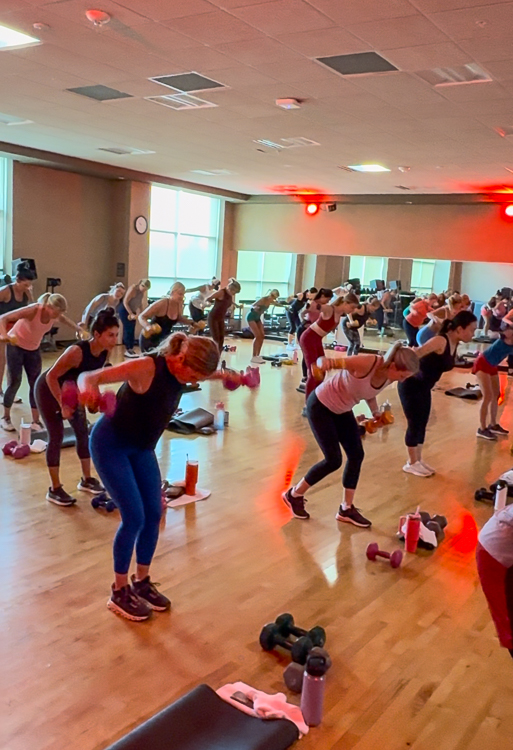
Speaking of weights, don’t lift weights so heavy that you don’t get full range of motion. Full range of motion is one of the most important parts of executing an exercise.
This is another big one! I love to see people in my classes challenging themselves, but I don’t want to see people choosing weights so heavy that they have trouble finding good form and full range of movement for motions. If your instructor gives you a cue on range (for instance, getting your hips down and back to 90 degrees or lower in a squat), that cue matters. If your weights are too heavy to find full range, you should pull back on your weights a bit.
Typically, depending on the focus of the class, you want to feel like you’re almost not able to finish an exercise when there’s about 10 to 15 seconds left of it. For example, in a barre class arms track, you should be able to handle the weights you choose and have great form all the way to the last 10 seconds or so, when you start to almost lose form. This is not an exact science, but it’s a general rule.
Take a good, hard look at your weekly routine, and make sure you have smart variety, as well as smart repetition.
I know some people like to take the same class format every single day. I also know some people like to take a different class format every single day. While both options mean that you’re a devoted group fitness participant (and I respect that), neither option is the most strategic if you want to get better results from taking group fitness classes. You need smart variety, but not too much variety. And you need repetition, but not too much repetition.
For instance, if you’re doing a muscular-endurance based class with a ton of repetitions per muscle group (I’m talking LIFT Barbell Strength at Life Time or Les Mills BODYPUMP at other locations), you shouldn’t be doing it every single day. When you lift weights, you create tiny tears in your muscles, and those tears grow back newer/stronger/better tissue over the next 24-48 hours when you’re away. That’s why, putting a little space between this type of barbell workout is important for you to keep growing, rather than hindering your progress without enough recovery time. (A barbell-based class could be done Monday, Wednesday and Friday, as an example, with a day off/alternative activity in between.)
I actually think I could devote a whole blog post to how to schedule a week or group fitness classes, but for now, here’s a general idea: Try to lift moderately heavy 2-3 times a week in a strength-based class, preferably with days off or with something else in between. Try to do a more mobility/flexibility workout maybe 1-3 times a week (these can be consecutive, but work best between tougher workouts). Make sure you take a rest day each week too. Also, a lot of group fitness classes have cardio elements, so you may be getting enough cardio there without a specific cardio workout. If not, you can add a cardio group fitness class and put it anywhere in your schedule, except right before your heavier-weight class — you want to be fresh for that one.
And of course, this is just a class schedule, you’re also free to lift weights and do cardio on your own outside of the group fitness studio.
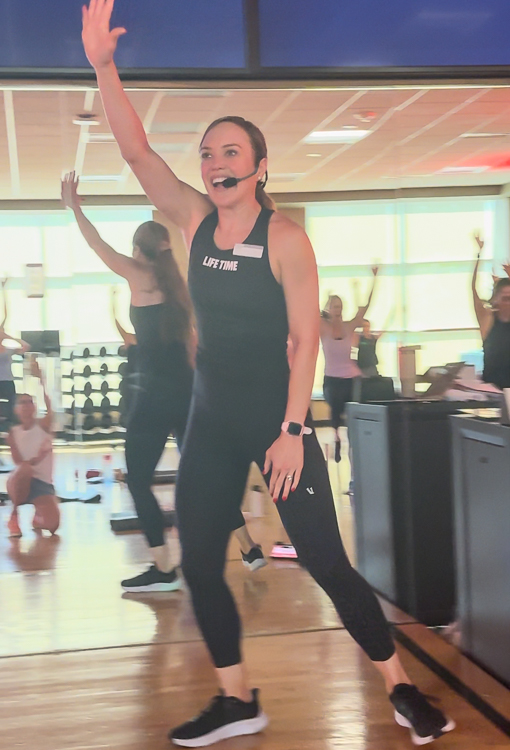
Take advantage of going to classes by asking more questions and seeking more feedback from your instructors.
No matter how long you’ve been going to a class, it’s okay to ask the instructor what you’re doing right and wrong and ask them to look out for you and your form. Oftentimes classes are too full and busy for you to get a ton of personal attention, but seek out the advice of the instructor when you can to make sure you’re getting the most out of the moves. You may be making mistakes you don’t even know about, which can be fixed with a simple tweak.
I always offer to my students to see me before or after class if they want personal help with a move that I can’t give during the workout. This is a great time to connect and give them a little assistance that could make their workout much better. Instructors love to help, so make sure you’re taking advantage of your instructor’s knowledge and asking more questions. It’s never too late to get help and make some small positive changes.
Be responsible for your own personal warm-up, cool-down and recovery.
You can get there early or stay late to work on additional things, outside of the class. I love to see people doing this.
I know that most people appreciate the fact that a group fitness class is a one-stop-shop for a warm-up, exercise and cool-down. And yes, that’s true, and yes, just attending a class is great. However, if you know you have some areas of concern or joints that tend to take longer to warm up, it would be smart to get there a bit early and do dynamic warm-up or mobility movements that work for you. Also, if you do a little bit of warming up before the class starts, your muscles will be more fired up and you’ll get more out of the movements.
In addition, the stretching portion of a group fitness class is usually pretty short. If you think you need more, stretch more.
I often tell my participants that they should be taking care of their bodies more and doing more recovery each week. Epsom salt baths, massages, foam rolling, restorative yoga, saunas, cold plunges, etc. These are all methods of recovery, and these methods can keep you injury free by helping your muscles to properly heal between classes.
Remember, you know your body better than anyone, so it may be a good idea to do an additional warm-up or cool-down before or after your group fitness classes in order to maximize your results.
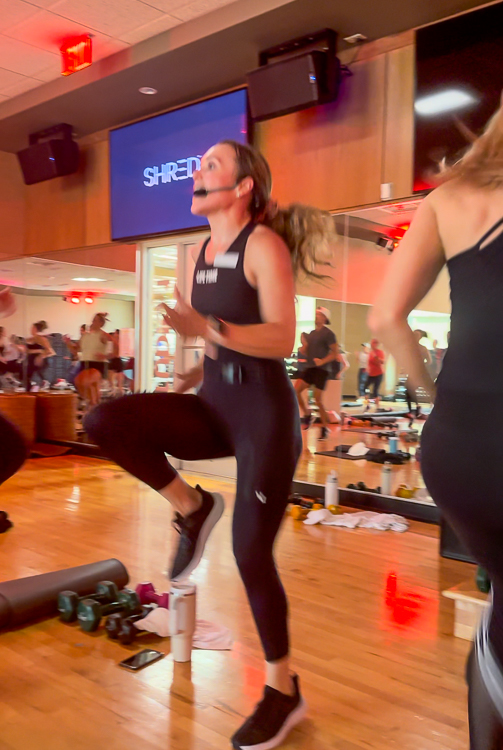
Additional tips on how to get better results from taking group fitness classes …
Do your very best in one class at a time, rather than half-assing two classes in a row. If you like to “double up” make sure aren’t just going through the motions in your two classes or your second class. It’s better to go full-out in one class, than do a half-effort workout in two classes in a row. Now, I’m not against doubling up, and I love to see participants join me for back-to-back workouts on the days I teach doubles. But I don’t think it’s necessary at all. One solid class is usually plenty.
Stay for the whole class (and be there on time to start from the beginning). If you’re showing up late to a class and missing the introduction or warm up, you’re severely short-changing your workout. If you’re running out and missing the final moments of the class, you’re missing out too. I know you’re busy and just trying to fit it in, but a class is supposed to be a full journey, and you don’t want to skip parts of that journey.
Consider meeting with a personal trainer for a single session to get your movement assessed. I love classes, I teach classes, and yet, I still send my participants out to the fitness floor sometimes. We’re lucky to have small-group training classes where I work (Life Time Charlotte), and that’s the best of both worlds where you’re doing a group-workout experience on the floor. But if you don’t have that where you work out, you may want a trainer session to check in with your form and offer you some help. This time with a trainer could be a great chance for you to improve little nuances in your basic movement patterns and learn where you have some imbalances that you need to work to correct too. This information will absolutely help you to get better results from taking group fitness.
Remember that nutrition is just as important as movement. If you’ve been going to group fitness classes a long time, and you don’t feel like you’re seeing changes in your fitness level or aesthetics, you may need to do some things differently. First up, you want to ensure you’re doing the movements right and finding the correct class line-up for you each week (points listed above in this post). Next up, you want to ensure you’re eating enough protein for your goals and body type. I talk to people each week about how they look/feel, and nearly every conversation ends with me telling that person to consider working out a little less and consider eating a lot more protein. Of course, that’s a blanket statement, but it’s worth sharing here too. I wrote a whole post about eating protein, and you can find that one here.
And that’s the post on how to get better results from taking group fitness!
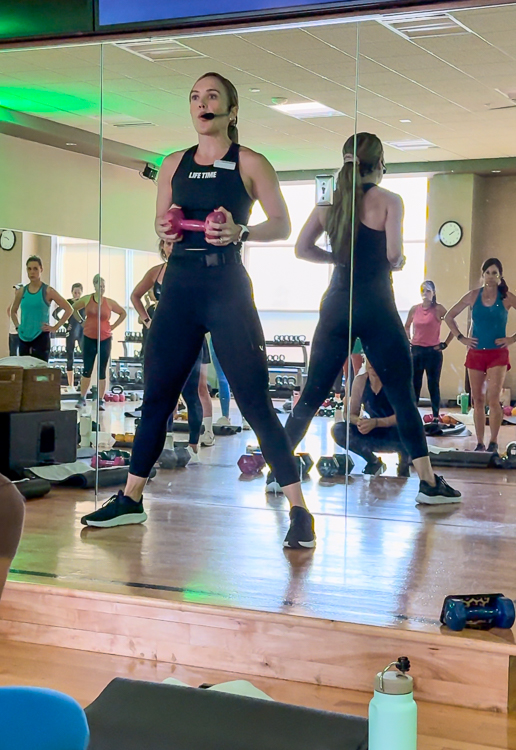
As you know, I love group fitness. And because you made it this far in this one, I’m guessing you love it too. There’s something so special about working out with others in a group fitness studio. But when you attend classes, instead of blending in, you’ve got to take ownership of your movement, your weight selection, your body’s individual needs, as well as your overall routine. I hope this post has offered some insight on just how to do that.
So get out there and sweat, my friend! Thanks for stopping by to read about how to get better results from taking group fitness classes.
Other posts you may like
- How to get stronger (and how I’ve increased my strength)
- Fitness terminology 101: Fitness and workout terms you should know
- Group fitness rules: How to be a polite group fitness participant
- Signs you’re taking a class from a bad group fitness instructor
Questions of the day
Are you a group fitness fan?
What’s the last group fitness class you’ve taken?
Great tips! It’s so key to talk to the instructor!
Sure is! 🙂
Such great tips Ashley! Although I’m totally guilty of hovering around the edges of classes vs. braving the middle. 🙂 It’s hard not to be self-conscious when you’re just starting out, even when you “know” no one is really watching you.
Hi Kim! Well maybe next time you’ll walk up to be front and center! 🙂
You know I love group fitness. 😉 Great tips here. I love that “try it 3x before you decide” tip…I tell my new members that all the time!
Thanks, Ashley. That’s definitely a good one. But I’m pretty sure I loved BODYPUMP the first time I took it. 🙂
“It’s okay, it’s just exercise.” Haha!
I love these tips! I’m glad I read through this as I’m navigating the San Francisco fitness scene. You’re right; it takes a few visits before you can decide if a workout is suited to you. I also feel like trying out several places is a good way for someone to better understand each of the individual experiences (for example, I thought I liked one workout but realized after attending other new classes that I actually did not have fun at the first one comparatively). I have been relying on group fitness classes for the past years, and I do think I should start focusing on myself a little more… at least with yoga since I don’t make it to a studio quite as much as I ever plan to, and I tend to feel like I’m not progressing. Food for thought, as always. Thanks for sharing this!
You’re so welcome. And it’s always going to be a journey, so hopefully you can continue to get better at every class you take. Enjoy!
Thanks for sharing these tips! I’ve been going to Body Pump for almost 2 years, but have switched gyms a few times. It’s never a bad idea to get to know the instructor a little bit. =) Body Pump and yoga are my favorites.. and I wish I was able to do more Barre. Have a great day!
Thanks, Emily! Yes, I can speak from experience that as an instructor, I love to learn more about my members. And BODYPUMP and yoga makes for a great combination. Have a lovely day:)
I really am a big believer in the group motivating the members individually. Group Fitness has exploded in the past few years and I am always looking for trying something new in San Francisco.
I recently started group fitness(March) and I am in love. I hated, I mean HATED, working out in any form. I found the right gym for me, with the right classes and the right other students.
The instructors make all the difference! I love that I can go at my pace, ask for modifications(burpees make me cry and they instructor was like “well instead of hopping, are you ok to take steps”?—YES!. I also find lunges really hard on my knees so they offered a side lunge modifications), and the fist bumps after a tough set are the best.
I really appreciate you calling out that the last 10 or so seconds is supposed to feel hard to do. That helps me feel better then it’s a struggle towards the end of class.
I’m taking Yoga on Monday, Fit & Flow on Tuesday(25 min of strength followed by yoga targeting the muscles used), Strength on Wednesday, HIIT on Fridays
Hi Sabrina! I love to know that you’re into group fitness now — it’s so cool to have the group aspect, be able to get help from an instructor and also know you can make modifications any time you need them. Your routine sounds great. Thank you so much for sharing that with me! Happy sweating! 🙂 xoxo